Business automation is entering a new phase. Instead of simply following predefined rules, AI agents can understand context, make decisions, interact with business systems and take action across multi-step workflows. From processing invoices to qualifying leads and resolving customer requests, they are changing what automation can accomplish.
But with dozens of AI agent platforms emerging in 2026, choosing the right one can be challenging. The best AI agents for business process automation 2026 are not necessarily the ones with the longest feature list. The right choice depends on your workflows, integrations, security requirements, budget and level of customisation. In this guide, we compare some of the leading AI agent platforms for business automation and explain what to look for before investing.
What Are AI Agents for Business Process Automation?
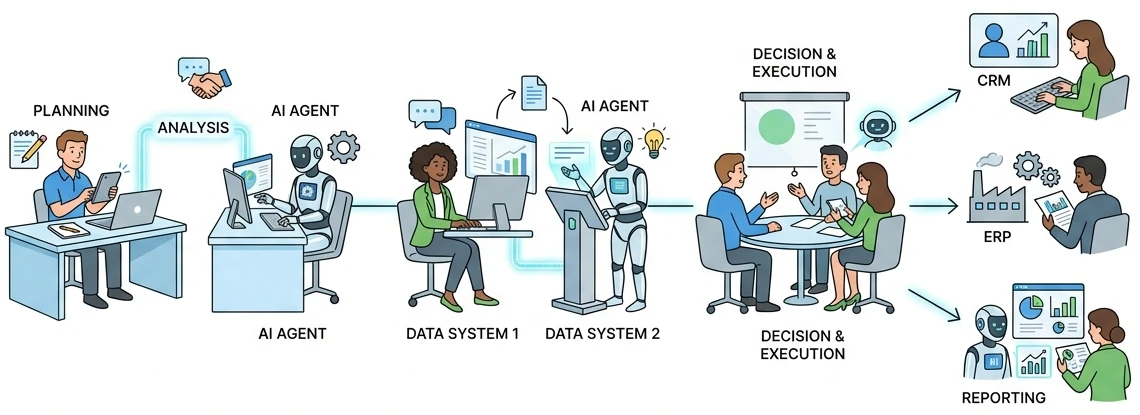
AI agents are software systems designed to pursue a defined business goal rather than simply execute a fixed sequence of commands. They can interpret information, reason about what should happen next, interact with applications and APIs, and take actions based on changing circumstances. For example, an AI agent handling accounts payable could receive an invoice, extract its details, compare them with purchase-order information, identify discrepancies, request clarification and route the invoice for approval. A traditional automation would generally require every condition and exception to be explicitly programmed.
This adaptability is why the best AI agents for business process automation 2026 are increasingly being evaluated for processes involving customer service, finance, HR, procurement, IT and document-heavy operations.
AI Agents vs RPA for Business Process Automation
The debate around AI agents vs RPA for business process automation is not necessarily about replacing one technology with another. In many organisations, the strongest architecture combines both.
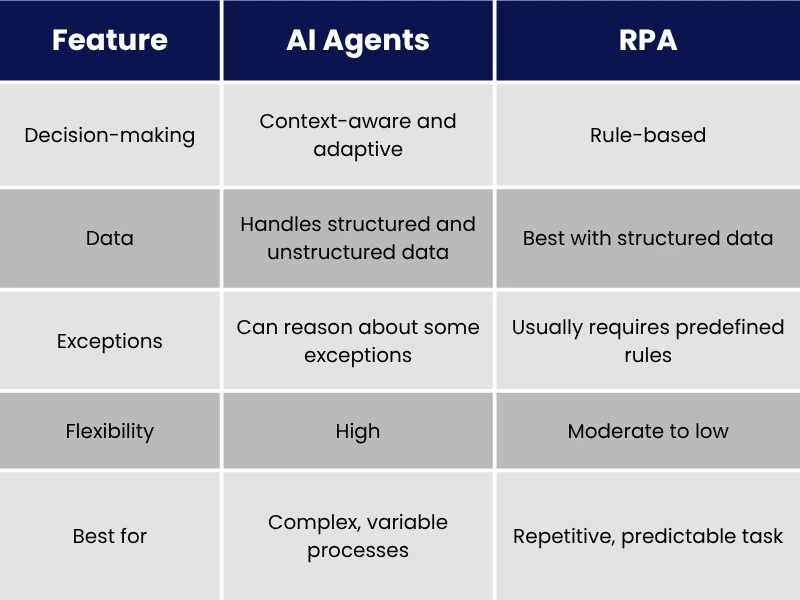
This combination is often described as intelligent process automation (IPA). RPA can execute predictable steps while an AI agent handles interpretation, decisions and exceptions. For example, an agent could determine which customer request needs escalation, while an RPA bot performs the repetitive data entry across a legacy application. This hybrid approach can extend automation without forcing organisations to abandon existing investments.
Ultimately, AI agents vs RPA for business process automation should be viewed as a workflow-design decision. The right technology depends on how predictable the process is, how much judgement it requires and what systems it needs to access.
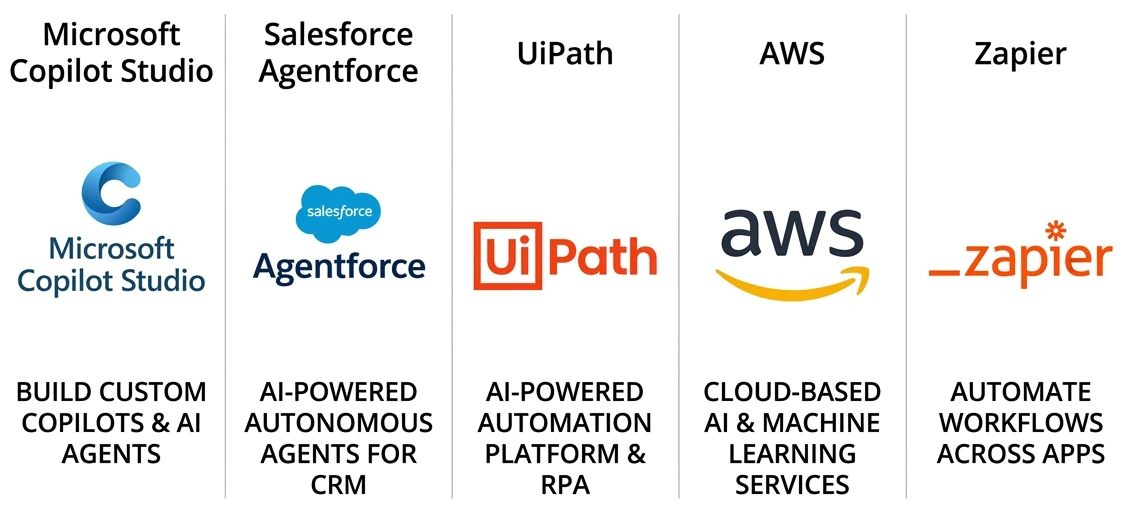
The Best AI Agents for Business Process Automation in 2026
There is no universal winner. The best AI agents for business process automation 2026 depend heavily on an organisation's existing technology stack, security requirements, workflow complexity and development resources.
1. Microsoft Copilot Studio - Best Overall for Enterprise
Microsoft Copilot Studio is a strong all-round choice for organisations already invested in Microsoft 365, Azure and Power Platform. It provides a low-code environment for creating agents and connecting them to business data and applications. As one of the best AI agents for business process automation 2026, its capabilities increasingly combine agents with workflows, computer-use automation and multi-agent orchestration. Microsoft has also expanded governance and visibility features for organisations managing agents at scale.
Best for: Microsoft-centric enterprises, employee workflows, customer service and cross-application automation.
2. Salesforce Agentforce - Best for CRM Workflow Automation
Salesforce Agentforce is particularly compelling when customer, sales and service data already live inside Salesforce. Agents can work with CRM context and perform actions through the Salesforce platform rather than operating as disconnected AI tools. Agentforce also provides APIs, SDKs and pro-code development options, making it suitable for organisations that want to extend beyond preconfigured agent experiences, making it one of the best AI agents for business process automation 2026.
Best for: Sales, customer service, CRM operations and customer-facing processes.
3. UiPath - Best for Document & Data Processing
UiPath stands out for organisations that already rely on RPA and want to add agentic capabilities without abandoning their existing automation estate. Its platform brings together agents, robots, process orchestration and human oversight. UiPath's Agent Builder provides a visual environment for configuring and testing agents, while its broader automation ecosystem makes it particularly useful for document-heavy and cross-system workflows.
Best for: Document processing, finance operations, legacy applications and RPA-to-agent transformation.
4. AWS Bedrock - Best for Developers / Custom Builds
For engineering teams that need greater control over architecture, models and deployment, AWS provides a strong foundation for custom agent applications. It is particularly suitable when AI agents need to be integrated deeply into existing cloud infrastructure. Rather than choosing a ready-made business workflow, development teams can build solutions around their own applications, APIs, data and security architecture.
Best for: Developer-led builds, AWS environments, custom applications and complex integrations.
5. Zapier Agents - Best Budget / SMB Option
Zapier Agents is a practical option among the best AI agents for business process automation 2026 for smaller teams that want to connect AI-powered automation to a broad range of SaaS applications without building an extensive engineering infrastructure. Zapier's wider automation ecosystem supports thousands of applications, making it useful for tasks such as lead handling, customer follow-ups, data synchronisation and internal administrative workflows.
Best for: Smaller businesses, quick deployments and teams with many SaaS applications.
How to Choose the Right AI Agent
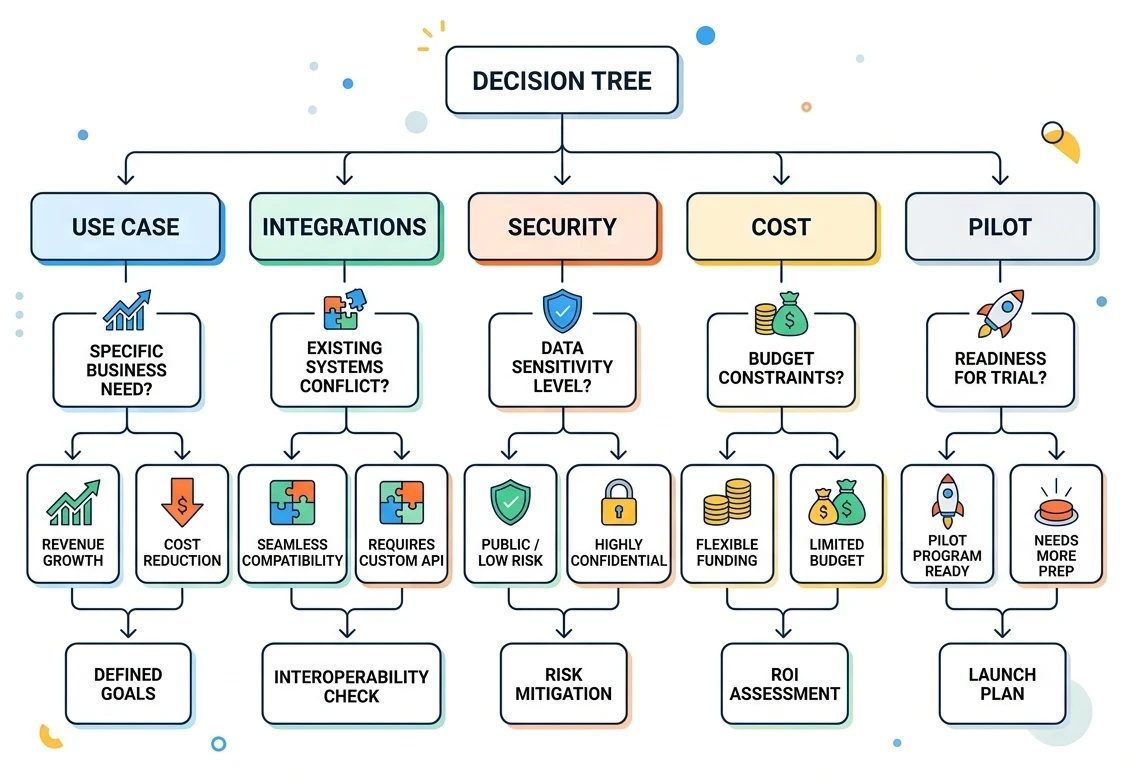
Choosing from the best AI agents for business process automation 2026 requires looking beyond demonstrations and feature lists.
Start With the Use Case:
Identify a process with measurable inefficiency, such as invoice handling, lead qualification, customer support or employee onboarding. Define what the agent should decide and what actions it should perform.
Check Integrations:
An impressive agent is of limited value if it cannot securely access the systems your business already uses. Evaluate APIs, connectors, databases, CRM platforms and legacy applications before selecting a platform.
Evaluate Security and Governance:
Consider authentication, access controls, audit logs, data handling, monitoring, human approvals and compliance requirements. Enterprise agents should operate within clearly defined boundaries.
Understand the Cost Model:
AI-agent pricing can vary considerably. Some platforms use seats, credits, actions, conversations or consumption-based pricing. Estimate expected usage before committing, particularly for high-volume workflows.
Pilot Before Scaling:
Start with one well-defined process. Establish KPIs such as processing time, error rate, human intervention and cost per transaction. A successful pilot provides evidence for expanding automation into other workflows.
This approach also supports intelligent process automation (IPA) by combining AI reasoning with structured workflow execution rather than attempting to make every process fully autonomous from day one.
Frequently Asked Questions
What is the difference between AI agents and RPA?
RPA follows predefined rules and works best when processes are predictable. AI agents can interpret context, make decisions and adapt their actions when circumstances change. In practice, organisations can combine both technologies, using agents for reasoning and RPA for deterministic execution.
How much do AI agents for automation cost?
There is no single price. Costs depend on the platform, number of users, agent usage, integrations, model consumption and implementation complexity. Some tools use subscriptions, while others use credits or consumption-based pricing. A pilot can help establish the real cost before wider deployment.
Can small businesses use AI agents?
Yes. Smaller businesses can use AI agents for tasks such as lead qualification, email handling, appointment workflows, customer support and data entry. Cloud-based platforms and no-code tools can reduce technical barriers, allowing teams to automate useful processes without building an entire AI infrastructure.
Choosing the Best AI Agents For Business Process Automation 2026
The best AI agents for business process automation 2026 are not necessarily the platforms with the most features. They are the ones that fit your workflows, data, integrations, security requirements and operational goals.
Microsoft Copilot Studio is a strong enterprise choice, Salesforce Agentforce excels in CRM environments, UiPath is well suited to RPA-plus-agent automation, AWS supports highly customised builds, and Zapier Agents offers an accessible route for smaller teams. If you are unsure where AI agents can deliver the greatest value, Phen-Tech can help you identify automation opportunities, design intelligent workflows and build AI-powered solutions around your existing systems.
Ready to turn repetitive business processes into intelligent, scalable workflows? Contact Phen-Tech to explore AI development and business process automation services tailored to your organisation.