Healthcare software cannot treat security as a feature added after launch. HIPAA compliant software development must begin before code is written. When an application creates, receives, maintains, or transmits electronic protected health information (ePHI), its architecture, access controls, infrastructure, logging, and operational processes must support the HIPAA Security Rule. HIPAA compliant software development is therefore a technical and governance exercise, not simply an encryption task.
For healthcare organisations, SaaS providers, health-tech companies, and development teams, the question is whether the system has appropriate safeguards, documented risk management, controlled access, secure infrastructure, and the required contractual relationships. There is no official HIPAA certification; compliance means meeting applicable HIPAA Security Rule requirements and signing required BAAs.
Quick answer: HIPAA compliant software development means designing, building, deploying, and maintaining software that protects ePHI through appropriate safeguards while supporting requirements for confidentiality, integrity, availability, access control, authentication, auditing, transmission security, and business associate relationships.
What is HIPAA-compliant Software Development?
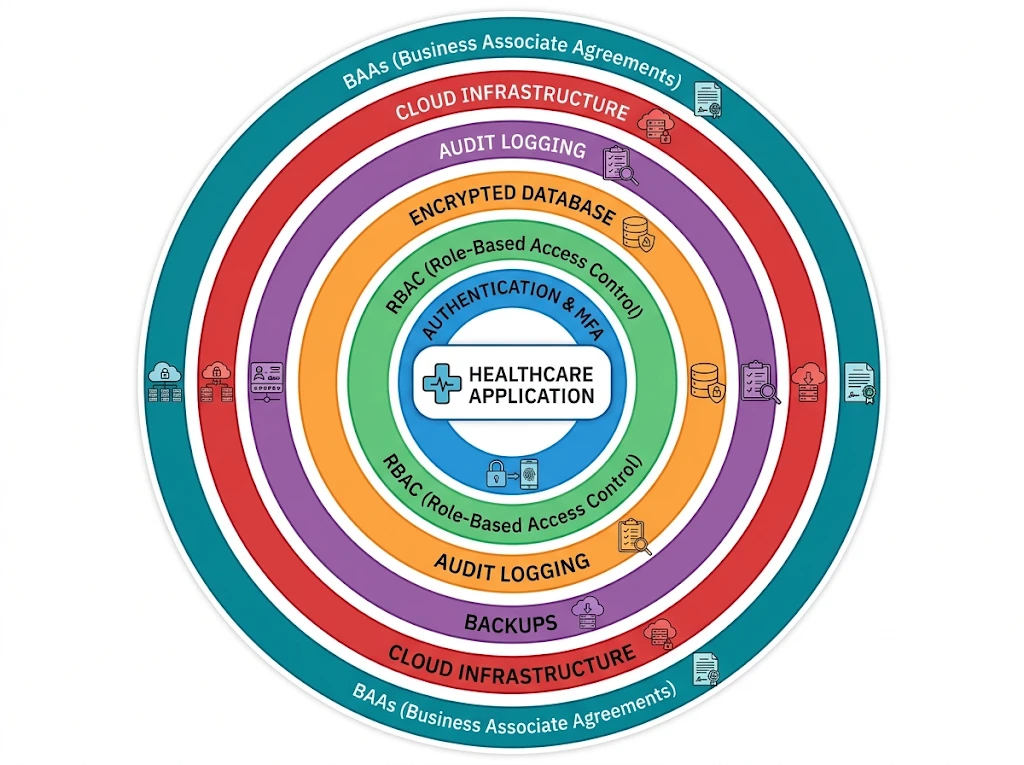
HIPAA compliant software development is an approach in which privacy and security requirements are treated as system requirements from architecture through maintenance. It starts by understanding what the Security Rule requires. The Security Rule requires covered entities and business associates to protect ePHI's confidentiality, integrity, and availability using reasonable and appropriate safeguards. For developers, this means authenticated access, role-based authorisation, protected data flows, activity logging, integrity mechanisms, secure configuration, incident response, and reliable recovery.
HIPAA does not prescribe a programming language, framework, database, or cloud architecture; organisations select reasonable and appropriate measures based on risk.
Who Must Comply: Covered Entities vs. Business Associates
Covered entities generally include health plans, healthcare clearinghouses, and healthcare providers conducting certain electronic transactions. Business associates are organisations performing certain functions or services for covered entities that involve PHI, plus certain subcontractors handling PHI for business associates. For software teams, a vendor that hosts, maintains, processes, or accesses PHI may become a business associate. Simply selling software does not automatically create that relationship; access to PHI and the service being provided matter.
A HIPAA compliance checklist for software should therefore begin with a data-flow map showing who creates, receives, maintains, or transmits ePHI. Include developers, cloud providers, email services, monitoring tools, analytics platforms, support systems, and other subprocessors.
The Three Types of HIPAA Safeguards
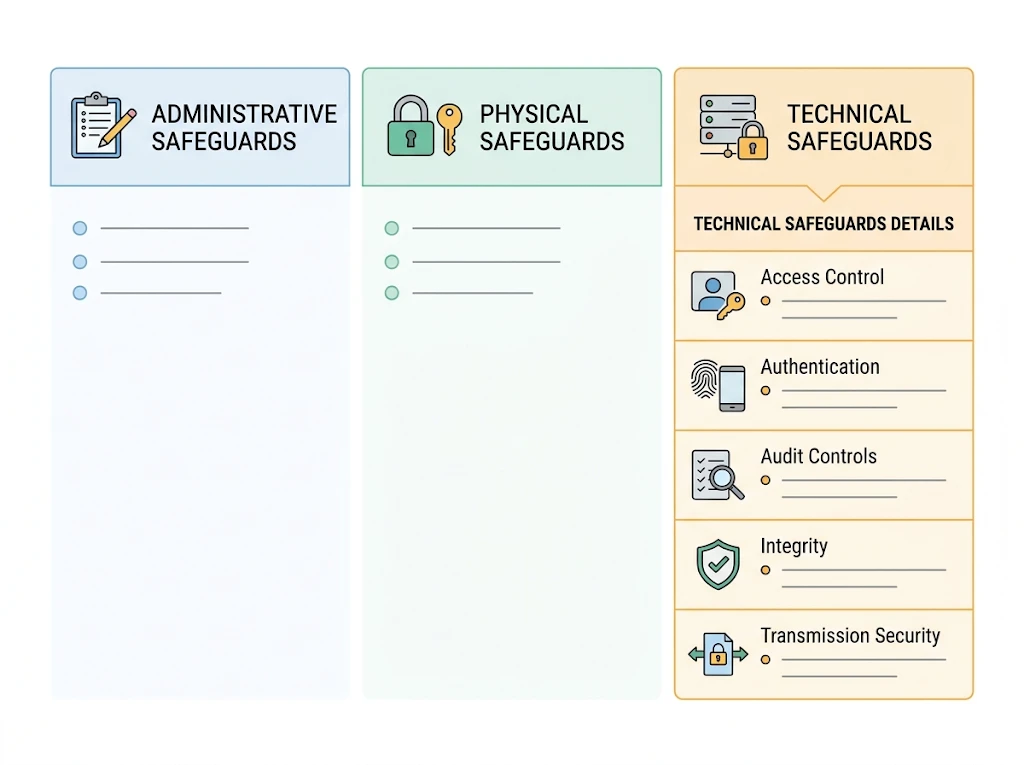
The Security Rule divides safeguards into administrative, physical, and technical categories.
Administrative safeguards
Administrative safeguards cover risk analysis, security management, workforce security, information access management, security awareness, incident response, contingency planning, and evaluation. For development teams, security requirements should be documented, ownership assigned, and changes assessed for security impact.
Physical safeguards
Physical safeguards protect facilities, workstations, devices, and media that can access or contain ePHI. Even cloud-first software must account for infrastructure facilities, endpoints, device management, and media disposal.
Technical safeguards
Technical safeguards are technology-based controls and related procedures. Their core standards include access control, audit controls, integrity, person or entity authentication, and transmission security. These form the foundation of the HIPAA technical safeguards developers implement in an application and its infrastructure.
HIPAA Technical Requirements Checklist for Developers
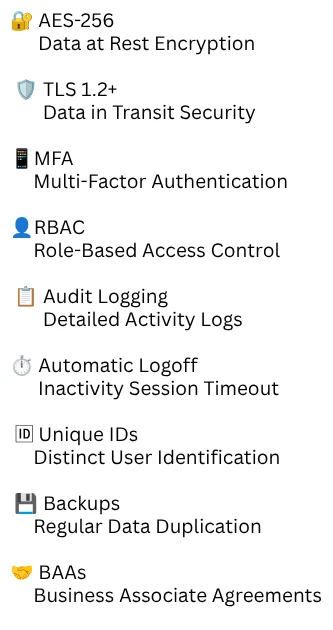
A practical HIPAA compliance checklist for software should translate the HIPAA Security Rule into specific, testable controls. The following checklist maps common implementation practices to the relevant Security Rule standards:
| Technical requirement | HIPAA Security Rule standard | What developers should implement |
| Encrypt ePHI at rest and in transit | Transmission Security (§164.312(e)) | Use strong encryption for stored ePHI, such as AES-256, and TLS 1.2+ for data transmitted across networks. Encryption specifications should be selected based on the organisation's risk analysis. |
| Role-based access control and minimum necessary access | Access Control (§164.312(a)) | Restrict ePHI access according to job responsibilities and apply the minimum-necessary principle. Implement role-based permissions rather than broad application-wide access. |
| Multi-factor authentication | Person or Entity Authentication (§164.312(d)) | Verify that a user or entity seeking access is who they claim to be. MFA is a strong implementation measure, particularly for privileged users and accounts accessing ePHI. |
| Audit controls and audit logging | Audit Controls (§164.312(b)) | Implement mechanisms that record and examine activity in systems containing or using ePHI. Log relevant access, changes, exports, administrative actions, and security events. |
| Automatic logoff / session timeout | Access Control (§164.312(a)(2)(iii)) | Automatically terminate or lock sessions after a defined period of inactivity to reduce the risk of unauthorised access from unattended devices. |
| Integrity controls | Integrity (§164.312(c)) | Implement mechanisms to protect ePHI from improper alteration or destruction. Depending on the architecture, this can include database controls, checksums, versioning, validation, and tamper detection. |
| Secure backup and disaster recovery | Contingency Plan (§164.308(a)(7)) | Maintain data backup, disaster recovery, emergency-mode operation, and testing procedures so ePHI remains available when systems are disrupted. |
| Unique user IDs; no shared accounts | Unique User Identification (§164.312(a)(2)(i)) | Assign each authorised user a unique identifier so system activity can be attributed to the correct individual. Avoid shared credentials that undermine accountability and logging. |
| BAAs with applicable subprocessors | Business Associate Contracts (§164.308(b)) | Establish appropriate BAAs with business associates and subcontractors that create, receive, maintain, or transmit PHI. This can include relevant hosting, email, monitoring, analytics, and other service providers. |
What the standards mean in practice
These standards should not be treated as a simple configuration checklist. HIPAA uses a risk-based and flexible approach, so the exact technical implementation depends on the organisation, its environment, the nature of its ePHI, and its documented risk analysis. For example, HIPAA's Audit Controls standard requires mechanisms to record and examine activity in systems containing or using ePHI. Developers therefore need more than an application error log: audit controls and audit logging should support meaningful review of relevant access and system activity.
Similarly, HIPAA's Person or Entity Authentication standard requires verification of identity but does not prescribe one universal authentication technology. MFA can provide a stronger implementation, while the appropriate authentication architecture should reflect the system's risk profile. The same principle applies to encryption. HIPAA does not simply state that every system must use AES-256. Developers should select appropriate encryption mechanisms based on the applicable Security Rule requirements and documented risk assessment.
Business Associate Agreements (BAAs)
HIPAA compliant software development also depends on getting the contractual layer right. A Business Associate Agreement is required when a business associate relationship exists. It establishes permitted and required uses and disclosures of PHI and requires the business associate to safeguard it appropriately. Identify every service that handles ePHI, determine whether it is a business associate or subcontractor, and confirm the appropriate agreement before regulated data flows through it. A SaaS vendor may have a BAA with a healthcare customer and separately need an appropriate arrangement with a cloud provider or other subprocessor handling PHI.
HIPAA-compliant Cloud Hosting: AWS and Azure
For HIPAA compliant software development, AWS and Microsoft Azure both provide services that can support HIPAA-regulated workloads, but neither cloud platform automatically makes an application compliant. AWS maintains a current list of HIPAA-eligible services and requires a BAA before eligible services are used for PHI. Azure provides BAA coverage for in-scope services and states that customers remain responsible for their own compliance and application configuration.
Cloud selection should therefore consider service eligibility, BAA coverage, encryption, identity and access controls, logging, backup architecture, monitoring, data flows, and the shared responsibility model.
Building HIPAA into the Development Lifecycle
HIPAA compliant software development works best when security controls are embedded throughout the SDLC. During discovery, HIPAA compliant software development teams should classify data and identify where ePHI enters, moves, changes, and leaves the system. During architecture, define trust boundaries, identity flows, encryption, secrets management, logging, backups, and recovery.
During development, use secure coding practices, dependency management, secrets scanning, code review, and controlled environments. Avoid live ePHI in development and testing unless there is a justified, appropriately protected need. During testing, verify authentication, authorisation, session management, encryption, input validation, logging, backup restoration, and failure scenarios. After launch, monitor access, review logs, patch dependencies, reassess risks, and test recovery.
Penalties for non-compliance
HIPAA enforcement can result in corrective action, resolution agreements, and civil money penalties. Weak access controls, missing logs, exposed backups, or poorly governed integrations can increase incident impact. Effective HIPAA compliant software development connects engineering controls with risk management and ongoing evaluation. Strong audit controls and audit logging are particularly important when investigating access events, security incidents, or suspected inappropriate changes to ePHI.
HIPAA compliance is an engineering discipline
HIPAA compliant software development is not achieved by choosing a “HIPAA-ready” cloud provider or adding encryption at the end of a project. It requires controls spanning identity, access, data protection, logging, integrity, availability, infrastructure, vendors, and ongoing risk management. The practical starting point is to translate the Security Rule into architecture and test requirements, map every ePHI data flow, and verify every third party that handles the data.
Build HIPAA-ready Software With Phentech
Phentech builds HIPAA-ready software for healthcare and medical technology use cases, with security considered across architecture, development, cloud infrastructure, and testing. Phentech is ISO 27001 certified, providing a formal information security management framework for its own organisation; this certification should not be represented as certification that a client's software is HIPAA compliant.
Schedule a consultation with Phentech to discuss your healthcare software requirements, architecture, security controls, and development roadmap.