Almost every article about off-the-shelf vs custom software is written by a custom development company. That creates an obvious conflict: if the company profits when you build, “build” can start looking like the answer to every problem. It should not be. For operations leaders and founders choosing a new business system, the better question is not “Can we build this?” It is “Do we need to?” Sometimes the smartest technology decision is buying an existing product and adapting your processes around it. In other cases, forcing a standard tool onto a genuinely differentiated operation creates years of workarounds, rising subscription costs and operational friction.
This guide provides a practical framework for deciding between the two without assuming that either option is automatically better.
Quick answer: Buy off-the-shelf when your process is standard, proven tools meet your requirements and speed matters. Consider custom when the process itself creates competitive advantage, per-user costs are becoming significant, or no existing product fits critical requirements. A hybrid approach often makes sense when only part of the workflow is genuinely unique.
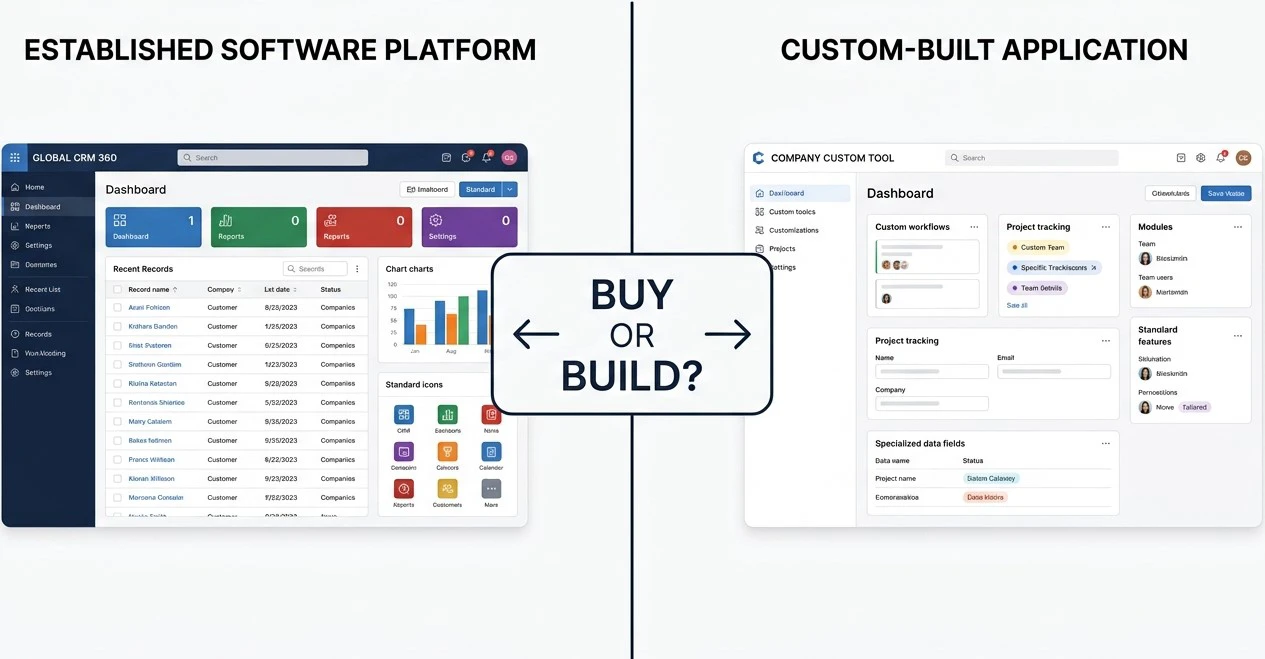
Off-the-Shelf vs Custom Software: The Core Difference
The fundamental difference in off-the-shelf vs custom software is who determines the product's functionality. With an off-the-shelf product, a vendor has already made most of the product decisions. Your organisation chooses a platform that broadly matches its requirements, configures the available settings and works within the vendor's product roadmap.
With custom software, your organisation determines the requirements first and development is carried out around those requirements. That provides greater control, but also transfers more responsibility for development, maintenance, security, updates and ongoing costs to you.
What 'off-the-shelf' (COTS) really means
Off-the-shelf software, also called Commercial Off-The-Shelf (COTS) software, is a commercially available product designed for a broad customer base. Examples include accounting platforms, CRM systems, project-management tools, payroll software and document-management systems. They typically provide configurable workflows, integrations, permissions and reporting without requiring your organisation to develop the underlying application.
The attraction is straightforward: the product already exists. Instead of funding a development project, you generally pay through a subscription, licence or other commercial model. You can often deploy the system within weeks or months rather than waiting for a development lifecycle. However, off-the-shelf software limitations become important when your workflows differ significantly from the assumptions built into the product.
What 'custom' / bespoke software really means
Custom software is developed around the specific requirements of an organisation, department or workflow. It can range from a relatively focused internal application to a large enterprise platform. The goal is not simply to create something different. The value comes from creating functionality that existing products cannot provide efficiently. This may include bespoke/tailored software for a highly specialised workflow, proprietary operational processes, unusual integrations or customer-facing functionality that directly differentiates a business. The trade-off is responsibility. Your organisation must account for development, testing, infrastructure, security, maintenance, support and future enhancements.
Side-by-Side Comparison
The off-the-shelf vs custom software decision becomes clearer when the practical differences are viewed together.
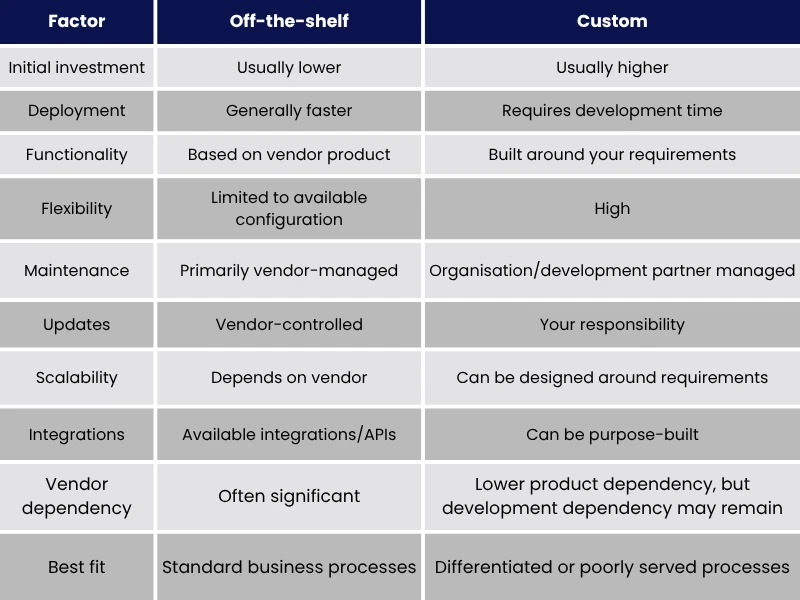
There is no universal winner. The right choice depends on whether the value comes from the software itself or from the process it supports.
When Off-the-Shelf Software Is the Right Choice
Off-the-shelf software is often the sensible option when your requirements are already common across your industry. If you need standard accounting, HR, CRM, collaboration, project management or payroll capabilities, there may be little strategic value in rebuilding functionality that established vendors already provide.
It can also make sense when:
- You need to deploy quickly.
- Your requirements are well understood.
- Several mature products meet your core needs.
- Your internal team cannot support long-term software development.
- The process is important but not a competitive differentiator.
- You prefer predictable vendor support and regular product updates.
This is where many off the shelf software limitations are acceptable. A few configuration compromises may be cheaper than funding a completely new system. The important distinction is between a genuine business requirement and a user preference. “Our team would prefer this button here” is not necessarily a reason to build. “This workflow prevents us from meeting a regulatory or operational requirement” is a different matter.
When Custom Software Is Worth the Investment
The key question in when to choose custom software is whether the limitations of existing products create a measurable business problem. Custom development may be justified when your organisation has a workflow that competitors cannot easily replicate, when multiple systems create significant manual work, or when existing products force employees into inefficient processes.
Consider custom development when:
- Your core workflow is genuinely unique.
- Existing platforms cannot support critical requirements.
- Employees spend substantial time maintaining workarounds.
- Multiple systems need to be connected through fragile processes.
- Per-seat licensing becomes expensive at your scale.
- You need functionality that vendors are unlikely to add.
- The software itself contributes to your competitive differentiation.
This is where bespoke/tailored software can become a strategic asset rather than simply another IT expense. However, “we have some unique requirements” is not enough. Every organisation has preferences. The question is whether those differences are sufficiently valuable to justify owning the development and maintenance burden.
The Hybrid Approach: Buy the Commodity, Build the Edge
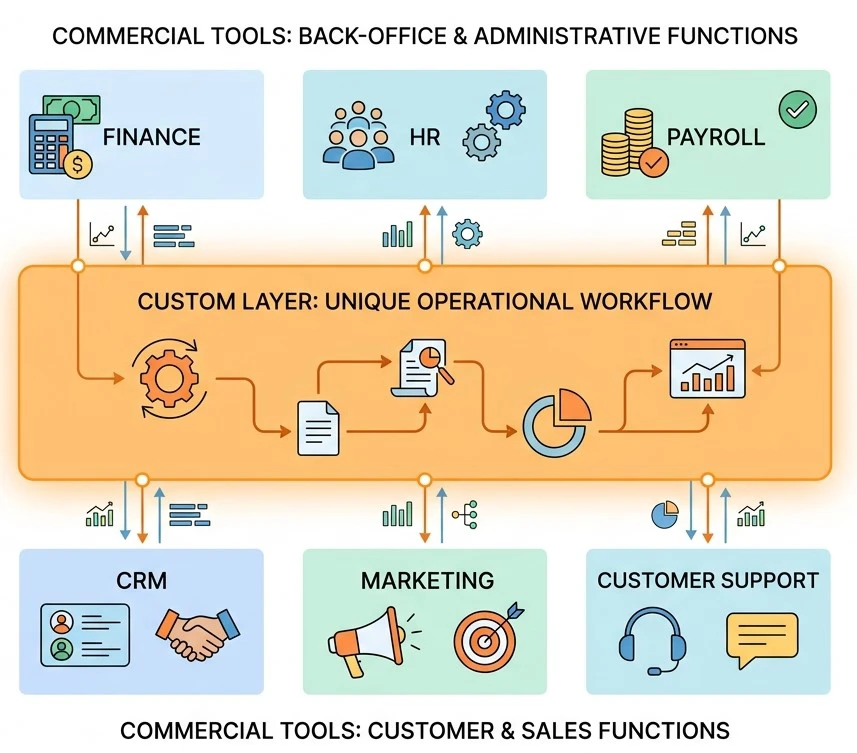
A hybrid strategy can remove the false choice at the centre of off-the-shelf vs custom software. Instead of replacing an entire category of commercial software, an organisation can buy established systems for standard functions and develop only the layer where differentiation matters. For example, a business might use an established finance platform, CRM and HR system while developing a custom operations layer that connects them and automates a specialised workflow.
This approach can provide access to mature capabilities without forcing the organisation to customise every part of its technology stack. It can also be a practical form of build vs buy software decision-making: buy what is already a commodity and build what creates measurable operational value. The result may include bespoke/tailored software around the edges rather than an entirely new technology ecosystem.
The Real Cost Comparison: Total Cost of Ownership
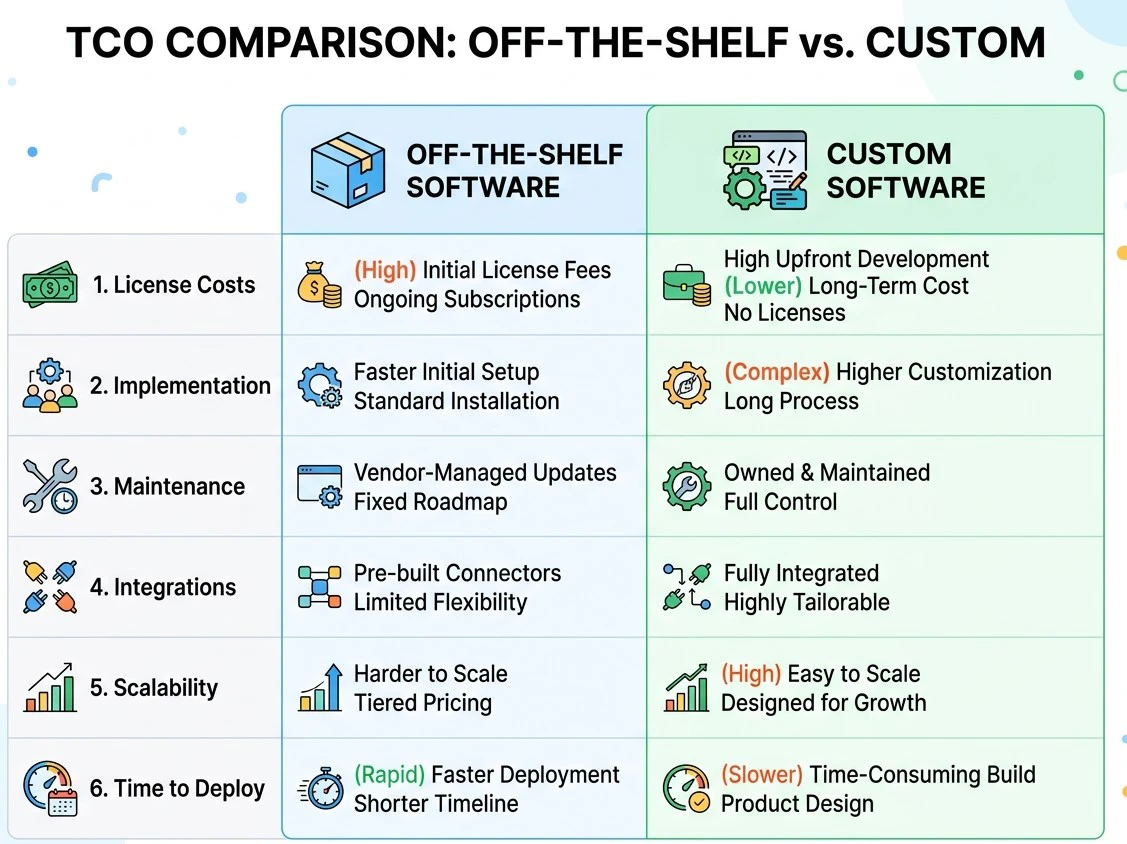
Comparing purchase price alone gives an incomplete picture of off-the-shelf vs custom software. For off-the-shelf products, total cost of ownership can include:
- Subscription or licence fees
- Implementation
- Data migration
- User training
- Integrations
- Premium modules
- Additional user or transaction charges
- Consultancy and configuration
- Switching costs if the vendor no longer fits your needs
For custom software, consider:
- Discovery and requirements
- Design and development
- Testing and deployment
- Infrastructure
- Security
- Maintenance
- Technical support
- Future enhancements
- Internal product ownership
- Recruitment or external development costs
A system that costs less to purchase can become expensive if employees spend thousands of hours working around it. Conversely, a custom application can be poor value if a mature commercial product already solves the problem effectively. For that reason, build vs buy software analysis should consider several years of operational costs rather than comparing a first-year subscription with a development quotation.
A Decision Checklist
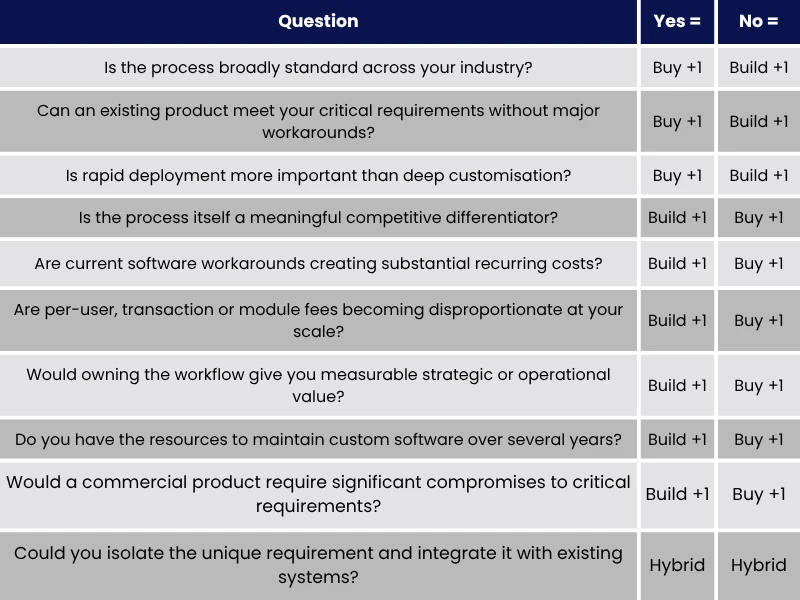
Use this simple scoring method before making an off-the-shelf vs custom software decision. Answer each question Yes or No.
How to interpret your score
Mostly Buy: Your requirements are likely well served by commercial software. Focus on vendor selection, implementation and total cost of ownership.
Mostly Build: There may be a stronger case for custom development, particularly if your unique processes create measurable business value.
Several Hybrid answers: Consider keeping standard capabilities in commercial platforms while developing only the differentiated layer.
The score is a starting point, not a substitute for financial and technical due diligence.
Need Help Deciding Whether To Build Or Buy?
The right answer to off-the-shelf vs custom software is rarely determined by technology alone. It depends on your processes, scale, costs, operational constraints and where your organisation actually creates value. If you are evaluating a new system, replacing an existing platform or questioning whether custom development is justified, we can help you assess the options before you commit to a build.
Talk through your requirements and explore the options at Phentech.