Digital transformation is no longer simply about moving applications to the cloud. Businesses need infrastructure that can scale with demand, control costs, support innovation, and remain secure as technology evolves. That makes cloud infrastructure management a critical foundation for organisations looking to turn digital investments into reliable business outcomes.
What Is Cloud Infrastructure Management?
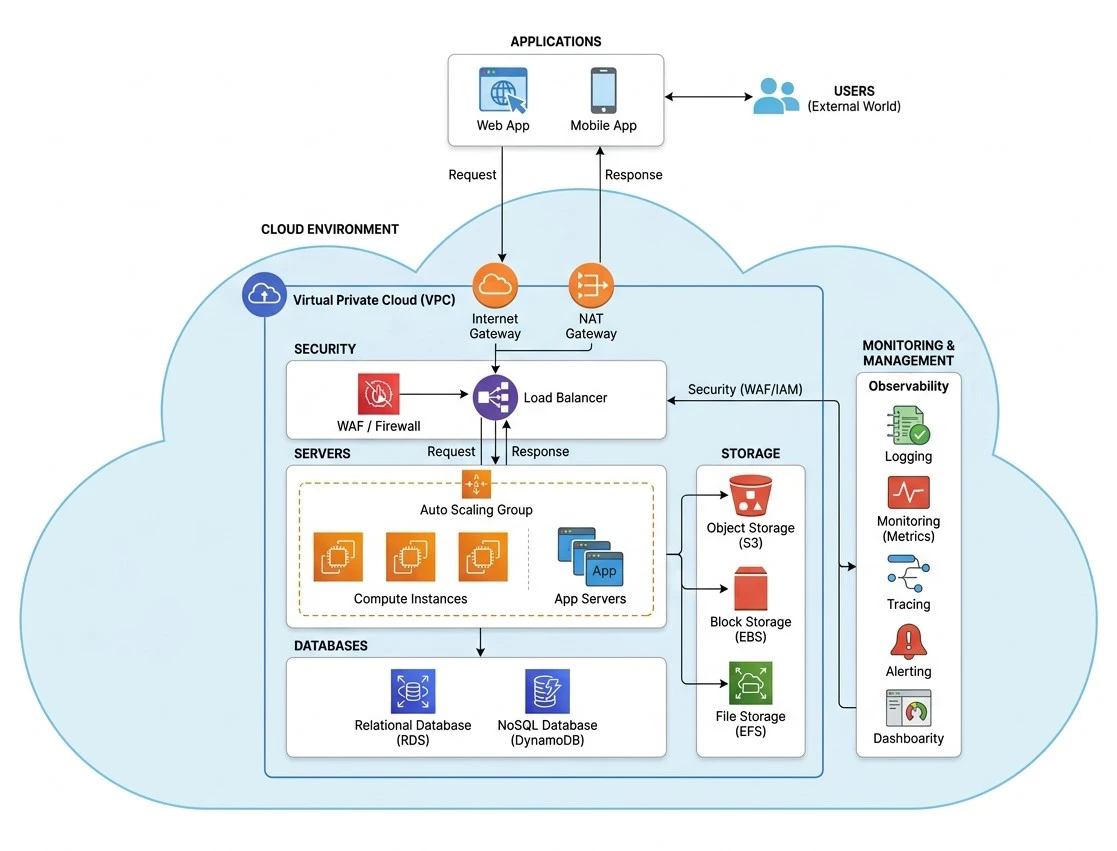
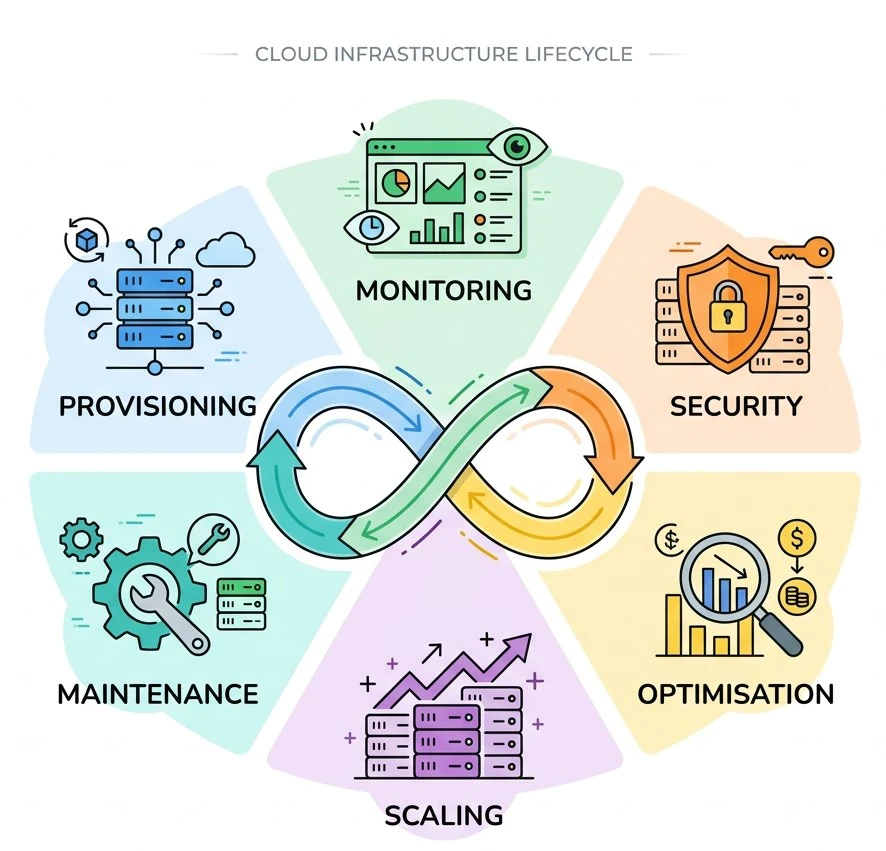
Cloud infrastructure management involves overseeing the cloud resources, configurations, workloads, and policies that keep digital systems running. It covers the infrastructure lifecycle, from provisioning servers and storage to monitoring performance, managing access, applying security controls, and scaling resources according to business demand. As organisations increasingly depend on cloud-based applications and services, infrastructure can quickly become complex. Without proper oversight, businesses may experience unnecessary costs, inconsistent configurations, security vulnerabilities, or performance issues.
A structured approach to cloud infrastructure management gives technical teams greater visibility and control while helping organisations align infrastructure performance with broader business objectives.
Cloud Resource Provisioning and Configuration
Provisioning involves creating and configuring the computing, storage, networking, databases, and other resources applications require. Standardised configurations and Infrastructure as Code can make deployments faster, more consistent, and easier to reproduce across environments.
Cloud Monitoring and Performance Management
Continuous monitoring helps teams track availability, resource utilisation, application performance, and potential infrastructure failures. Alerts can identify unusual activity or performance degradation before problems significantly affect users.
Cloud Security and Access Control
Infrastructure management also involves controlling who can access resources and what they are permitted to do. Identity management, encryption, network controls, vulnerability monitoring, and secure configurations help reduce risks across the environment.
Scaling and Infrastructure Maintenance
Cloud environments need to adapt as workloads change. Automated scaling can increase resources during periods of high demand and reduce capacity when demand falls. Regular maintenance, patching, and configuration reviews also help maintain a stable environment over time.
Key Pillars of Managing Cloud Infrastructure
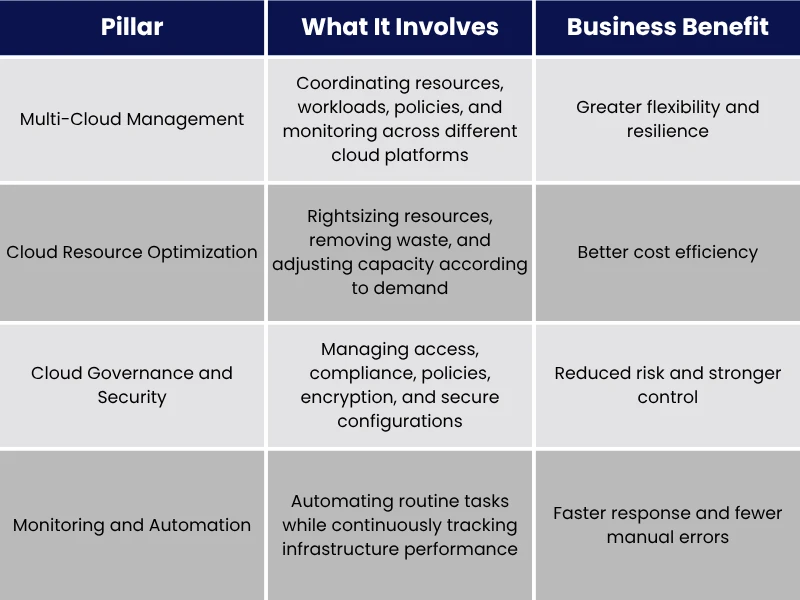
Effective cloud infrastructure management requires businesses to balance performance, scalability, cost, and security. Four key areas deserve particular attention:
Multi-Cloud Management
Many organisations use multiple cloud providers to access specialised services, improve resilience, or avoid excessive dependency on one platform. Multi-cloud management provides a structured way to monitor workloads, policies, performance, and costs across different environments. Without consistent visibility, multi-cloud environments can become difficult to control. Teams may encounter duplicated resources, fragmented monitoring, inconsistent configurations, and different security standards between platforms.
Cloud Resource Optimization
Cloud spending can increase quickly when resources are over-provisioned or left running unnecessarily. Cloud resource optimization focuses on matching infrastructure capacity with actual workload requirements. Businesses can optimise resources through rightsizing, autoscaling, removing unused resources, monitoring consumption, and selecting appropriate pricing models. Because workloads change over time, optimisation should be treated as an ongoing process rather than a one-time exercise.
Cloud Governance and Security
As cloud environments grow, organisations need clear rules for how resources are created, accessed, monitored, and secured. Cloud governance and security establish policies around identity, data protection, compliance, configurations, and resource usage. Security should be integrated into infrastructure decisions from the beginning rather than added after deployment. Role-based access, encryption, continuous monitoring, vulnerability management, and policy enforcement can help protect cloud environments without unnecessarily slowing innovation.
In-House vs Managed Cloud Infrastructure Services
Businesses can choose to manage their infrastructure internally or work with a specialist provider. An in-house approach gives organisations direct control and can be effective when they have experienced cloud engineers and sufficient resources for ongoing monitoring, maintenance, optimisation, and security. By comparison, cloud infrastructure management services provide specialist expertise and operational support. A provider may handle monitoring, maintenance, optimisation, security, backups, or other infrastructure responsibilities according to the organisation's requirements.
The choice ultimately depends on internal expertise, workload complexity, security requirements, budget, and growth plans.
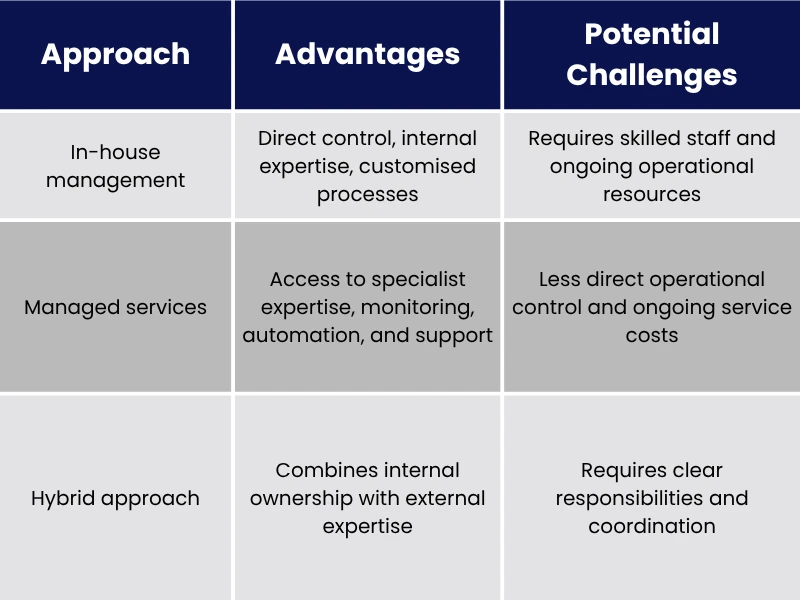
Managed cloud infrastructure can be particularly valuable for organisations that are scaling quickly, lack specialised cloud expertise, or need continuous infrastructure support without expanding their internal team.
Best Practices for Managing Cloud Infrastructure
A reliable cloud environment requires more than simply deploying resources. The following practices can help organisations maintain control as their infrastructure grows.
Use Infrastructure as Code
Define infrastructure through version-controlled configuration files rather than relying heavily on manual deployment. IaC improves consistency, simplifies replication, and reduces configuration errors.
Automate Repetitive Operations
Automate provisioning, scaling, patching, backups, and other repeatable processes wherever practical. Automation can reduce manual workloads and allow teams to respond faster to changing requirements.
Monitor Costs Continuously
Track spending by application, workload, department, or environment. Usage alerts, budgets, tagging policies, and regular reviews can reveal unnecessary spending before it becomes a major issue.
Build Security by Design
Security controls should be included from the beginning. Apply least-privilege access, encryption, network segmentation, secure configurations, logging, and vulnerability monitoring throughout the infrastructure lifecycle.
Prepare for Disaster Recovery
A cloud environment still needs a recovery strategy. Define recovery time and recovery point objectives, maintain appropriate backups, and regularly test recovery procedures to ensure systems can be restored when needed.
Build a Stronger Foundation for Digital Transformation
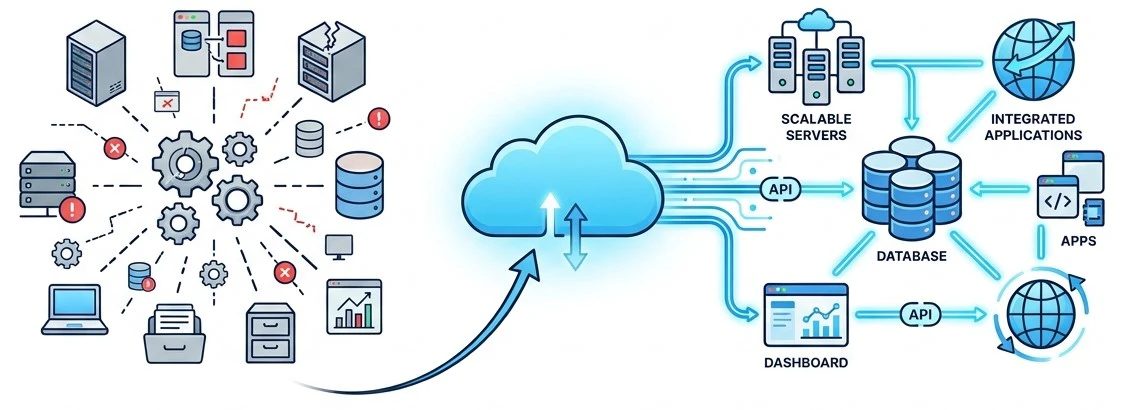
Digital transformation depends on more than applications and data. The infrastructure supporting them must remain scalable, secure, observable, and cost-efficient as business requirements evolve. A strategic approach to cloud infrastructure management gives organisations greater control over their cloud environments while creating a stronger foundation for innovation and growth. Whether you are modernising existing workloads, adopting multiple cloud platforms, or preparing for future expansion, effective infrastructure management can make cloud operations more predictable and sustainable.