Modern software teams need to deliver applications faster while maintaining quality, security, reliability, and scalability. A DevOps best practices checklist provides a structured way to improve development and operations processes, eliminate unnecessary manual work, and create a more efficient software delivery lifecycle.
What Is a DevOps Best Practices Checklist?
It is a practical framework that helps development and operations teams implement DevOps principles throughout the software lifecycle. It covers areas such as automation, continuous integration, infrastructure management, security, monitoring, collaboration, and performance measurement. Using a structured DevOps implementation checklist allows teams to identify process gaps, prioritise improvements, and introduce automation systematically. Instead of adopting tools without a clear purpose, teams can connect each technology to a specific delivery or operational objective.
The 15-Step DevOps Best Practices Checklist
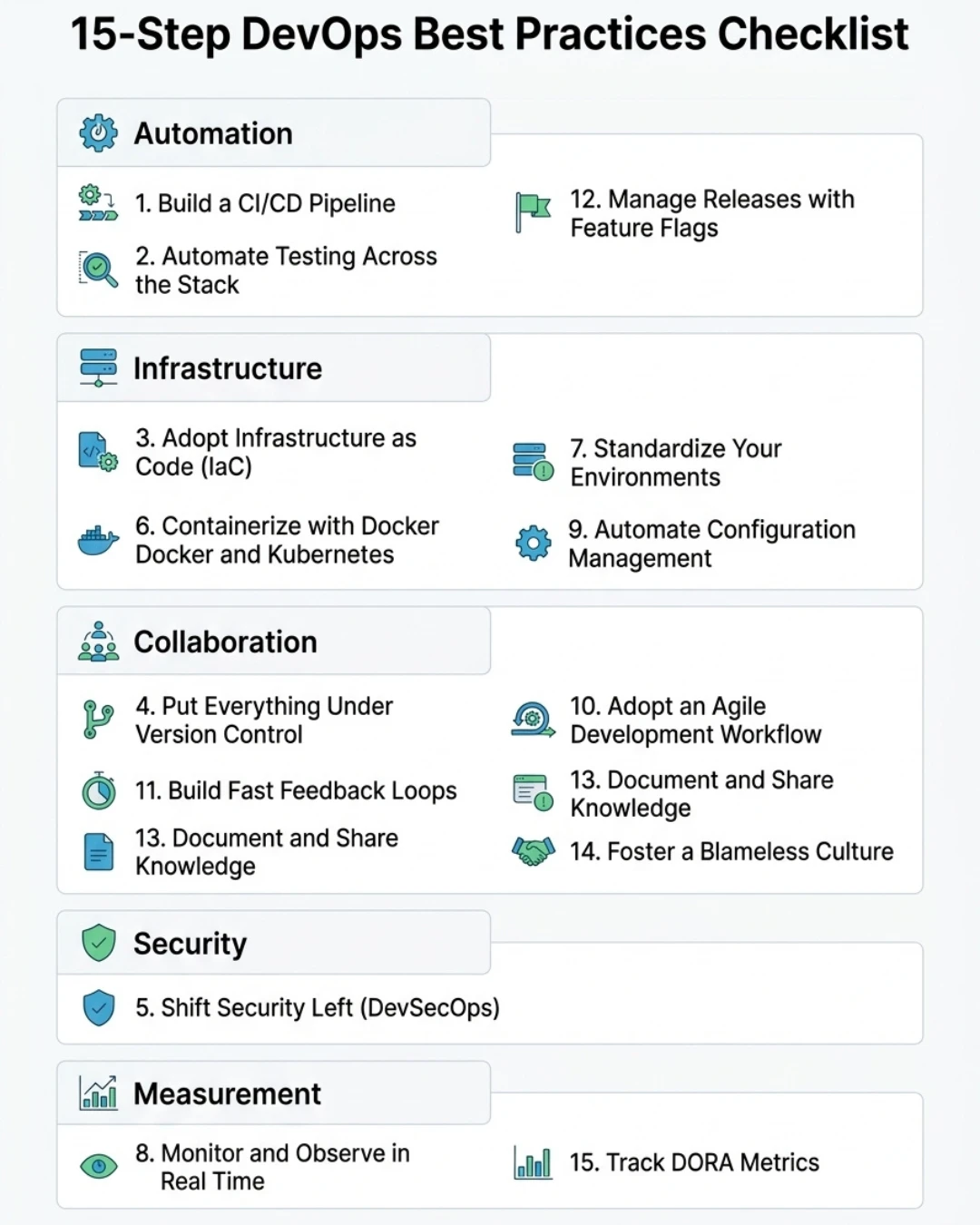
1. Build a CI/CD Pipeline
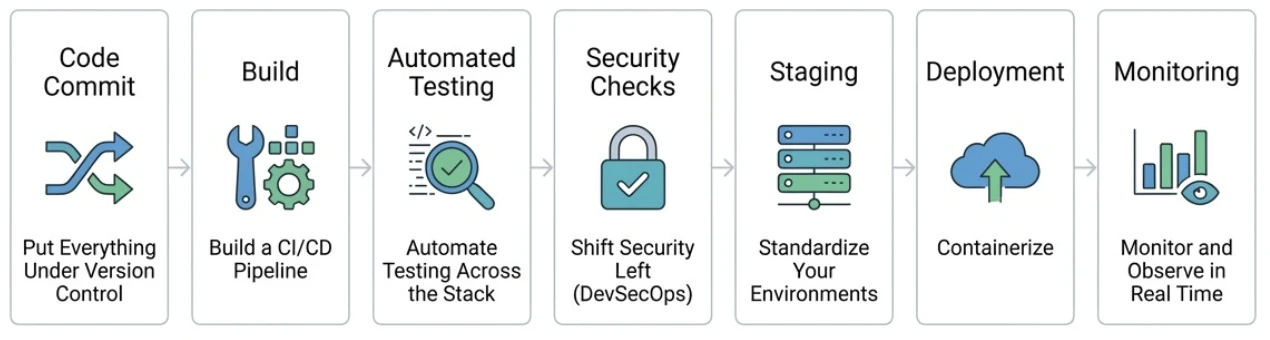
A CI/CD pipeline automates code integration, builds, testing, and deployment, allowing teams to release software more consistently. Start with a simple pipeline and gradually add automated quality, security, and deployment checks as the application matures.
2. Automate Testing Across the Stack
Automated unit, integration, API, security, and end-to-end testing helps identify defects before they reach production. Integrating tests into the CI/CD pipeline ensures that code changes are validated consistently without relying entirely on manual testing.
3. Adopt Infrastructure as Code (IaC)
Infrastructure as Code lets teams define servers, networks, databases, and cloud resources through configuration files instead of manual setup. Version-controlled infrastructure improves consistency, makes environments reproducible, and reduces configuration-related errors.
4. Put Everything Under Version Control
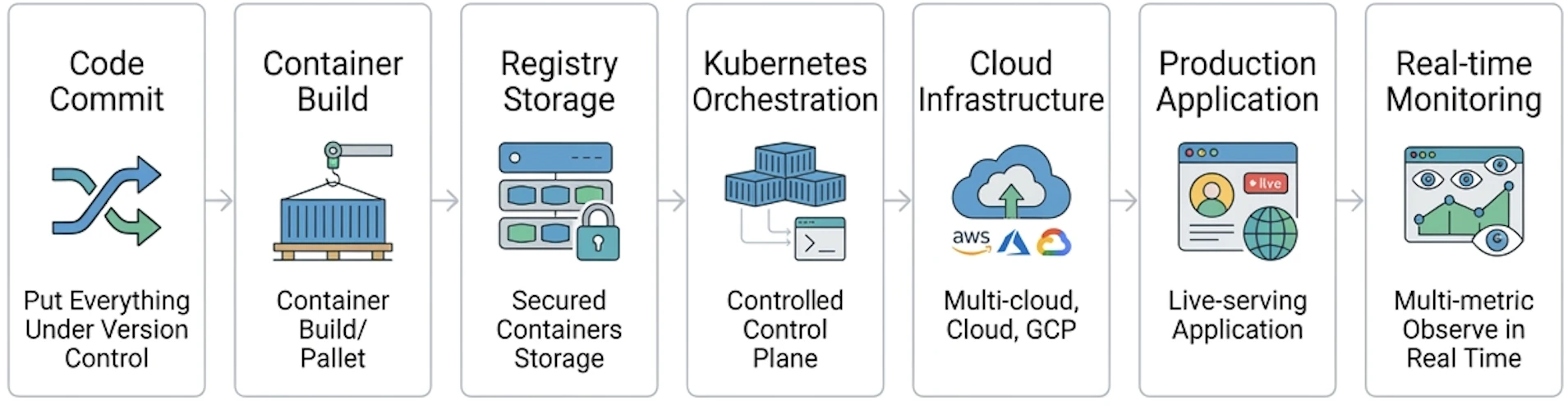
Keep application code, infrastructure configurations, deployment scripts, documentation, and other important DevOps assets in version control. This creates an audit trail, supports collaboration, and makes it easier to identify or reverse problematic changes.
5. Shift Security Left (DevSecOps)
For the next step in DevOps best practices checklist, security should be incorporated throughout development rather than treated as a final-stage review. Automated vulnerability scanning, dependency analysis, secrets detection, and code security checks can identify risks earlier and reduce the cost of remediation.
6. Containerize with Docker and Kubernetes
Containers package applications with their dependencies so they can run consistently across environments. Docker is widely used for containerisation, while Kubernetes can help teams orchestrate, scale, and manage containerised applications when their infrastructure requires it.
7. Standardize Your Environments
Differences between development, staging, and production can cause unexpected behaviour during deployment. Standardised configurations, automated provisioning, and reproducible infrastructure help minimise environment drift and make software releases more predictable.
8. Monitor and Observe in Real Time
Monitoring provides visibility into application performance, infrastructure health, availability, errors, and resource consumption and thus, is an integral step in DevOps best practices checklist. Combine metrics, logs, and traces to build observability that helps teams detect incidents quickly and investigate their underlying causes.
9. Automate Configuration Management
Manual configuration changes can create inconsistencies and increase operational overhead. Configuration management automation helps teams maintain predictable system states, apply changes consistently, and reduce repetitive administrative tasks across environments.
10. Adopt an Agile Development Workflow
An agile development workflow encourages smaller releases, iterative development, continuous collaboration, and regular feedback. Aligning agile planning with DevOps practices helps teams move from development to deployment more efficiently while keeping business and technical priorities connected.
11. Build Fast Feedback Loops
Fast feedback helps developers understand the impact of their changes before problems become expensive to fix. So a DevOps best practices checklist should include automated tests, code reviews, deployment notifications, monitoring alerts, and user feedback which can all shorten the distance between making a change and learning from it.
12. Manage Releases with Feature Flags
Feature flags separate deploying code from making a feature available to users. They enable gradual rollouts, targeted releases, controlled experimentation, and faster rollback without necessarily requiring another application deployment.
13. Document and Share Knowledge
DevOps works best when operational knowledge is accessible across the team instead of being concentrated with a few individuals. Document deployment processes, architecture decisions, troubleshooting procedures, incident responses, and operational standards in a central location.
14. Foster a Blameless Culture
A strong DevOps best practices checklist culture treats incidents as opportunities to improve systems and processes rather than opportunities to assign blame. Blameless post-incident reviews encourage teams to investigate root causes, share lessons, and implement changes that reduce the likelihood of repeat failures.
15. Track DORA Metrics
DORA metrics help teams measure software delivery performance using deployment frequency, lead time for changes, change failure rate, and recovery time from failed deployments. Tracking these indicators helps organisations identify bottlenecks and measure whether delivery improvements are actually working.
DevOps Best Practices for Startups
DevOps best practices for startups should focus on creating efficient processes and DevOps best practices checklists without introducing unnecessary complexity. Startups can begin with source control, automated testing, a basic deployment process, cloud infrastructure, and essential monitoring before expanding into more advanced practices. The goal is to keep the technology stack lean while establishing scalable engineering habits. A focused DevOps implementation checklist can help a startup prioritise the highest-impact improvements, automate repetitive work, and add more sophisticated capabilities only when they provide clear value.
A practical approach to DevOps best practices for startups also means choosing managed services where appropriate and avoiding tools simply because they are popular. The right solution is the one that fits the team's skills, application architecture, budget, and growth plans.
Frequently Asked Questions
What is the first step in a DevOps checklist?
The first step is to assess the current software delivery lifecycle and identify its biggest bottlenecks. Teams should then prioritise foundational practices such as version control, automated builds, and deployment automation. Establishing a reliable baseline makes it easier to introduce testing, security, infrastructure automation, and monitoring progressively.
Is DevOps suitable for small startups?
Yes. DevOps can be highly valuable for small startups because automation reduces repetitive work and helps small teams deliver reliably without expanding operational overhead too quickly. Startups can begin with a focused set of practices and managed cloud services, then scale their DevOps capabilities alongside their products and engineering teams.
What tools are essential for DevOps in 2026?
There is no universal DevOps toolset. Most teams need version control, CI/CD automation, automated testing, infrastructure-as-code capabilities, security scanning, containerisation where appropriate, and observability tools. The best choices depend on the application's architecture, cloud environment, team expertise, compliance requirements, and delivery goals.
Make Software Delivery Faster and More Reliable
A DevOps best practices checklist gives teams a practical roadmap for improving software delivery across development, infrastructure, security, and operations. From automation and testing to observability, release management, collaboration, and DORA metrics, each practice can address a specific source of delivery friction. The strongest DevOps transformations do not happen by adopting every tool at once. They happen by identifying the biggest bottlenecks, automating high-value processes, measuring results, and continuously improving the delivery lifecycle.
Ready to streamline your software delivery? Talk to the Phentech team today to build a DevOps strategy aligned with your technology stack and business goals.