Supply chains depend on the smooth movement of products, information, and resources from suppliers to customers. ERP software for supply chain management connects these activities in one central system, helping businesses manage inventory, procurement, logistics, forecasting, and reporting with greater visibility and control.
As supply networks become more complex, disconnected spreadsheets and standalone applications can make it difficult to track what is happening across the operation. A well-designed ERP platform brings these workflows together so decision-makers can work with consistent, up-to-date information.
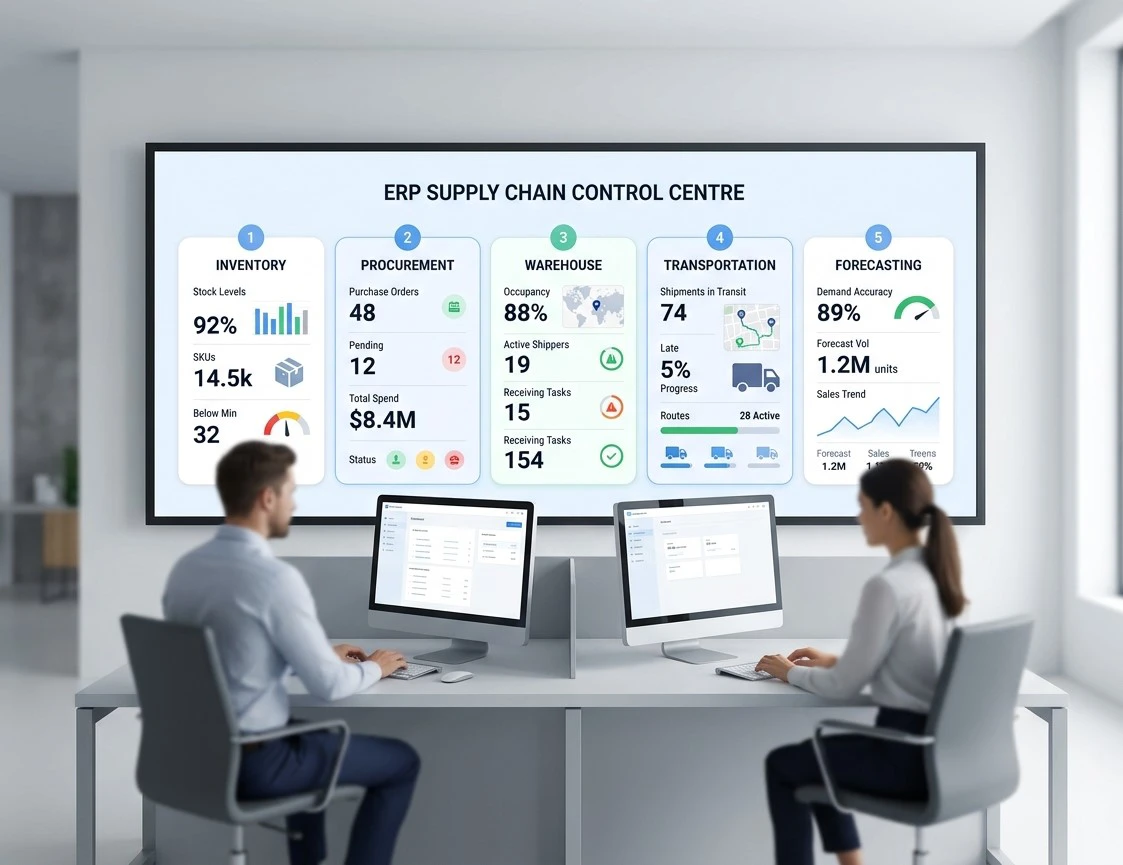
What Is ERP Software for Supply Chain Management?
ERP software for supply chain management is an enterprise platform designed to coordinate supply-chain processes through a shared digital environment. It can connect purchasing, inventory, warehouses, transportation, suppliers, sales data, and reporting, creating a unified flow of operational information. Instead of maintaining separate systems for each department, businesses can use one platform to track materials from procurement through delivery. This can reduce duplicate data entry, improve visibility, and help teams respond faster when demand, inventory levels, or delivery schedules change.
How Supply Chain ERP Differs From General ERP
Traditional ERP platforms often prioritise finance, accounting, human resources, and administrative functions. A supply-chain-focused platform places greater emphasis on operational workflows.
Supply chain ERP software typically provides deeper capabilities for stock control, purchasing, warehouse operations, transportation, supplier coordination, and demand planning. It can also integrate operational data with financial and business functions, giving management a more complete view of performance.
Who Needs an ERP System for Logistics?
An ERP system for logistics can benefit manufacturers, distributors, wholesalers, retailers, e-commerce businesses, and organisations managing complex supplier or delivery networks. It is particularly valuable when a business has multiple warehouses, high inventory volumes, numerous suppliers, frequent purchase orders, or geographically distributed operations. In these environments, centralised information can make it easier to identify delays, stock issues, and process bottlenecks.
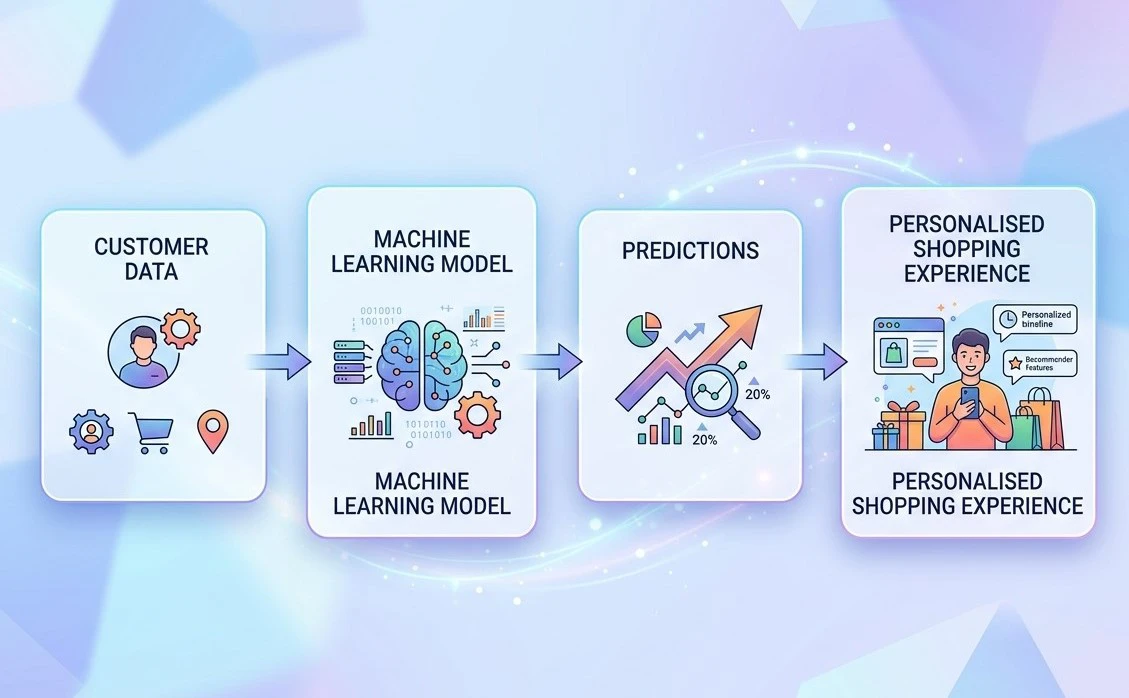
Key Features of Supply Chain ERP Software
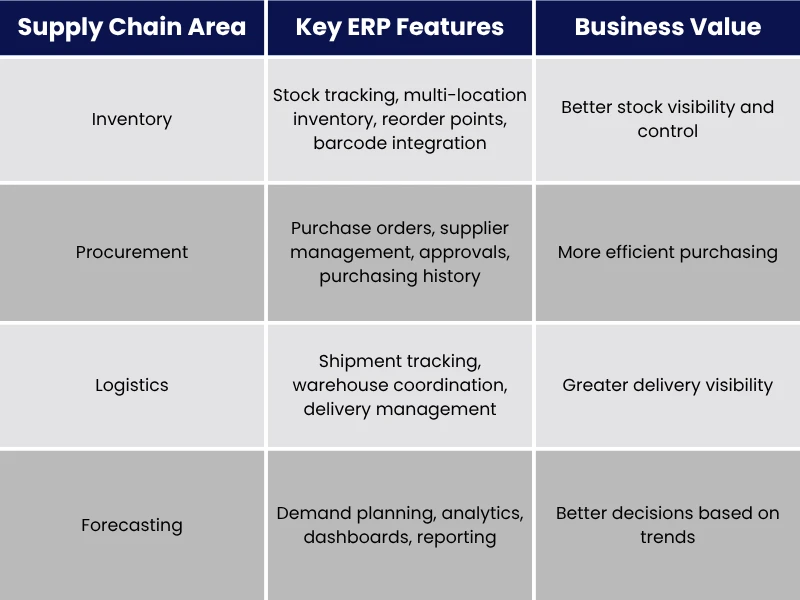
The most useful platforms connect core supply-chain activities rather than treating each function as an isolated module.
Inventory Management System Integration
An integrated inventory management system gives teams visibility into stock quantities, locations, movements, and availability. ERP integration can connect warehouse activity with purchasing and sales information, helping businesses understand when stock is moving in or out. Features may include barcode or scanner integration, automated reorder alerts, batch and serial tracking, multi-warehouse management, stock transfers, and inventory reporting.
This becomes especially important when businesses operate across several locations. Instead of relying on separate records, teams can view inventory information within the wider ERP environment.
Procurement Management Tools
Effective procurement management extends beyond creating purchase orders. Supply-chain ERP platforms can support supplier records, approval workflows, purchasing history, quotation management, purchase requisitions, and order tracking. By connecting purchasing with inventory levels and demand information, businesses can make more informed buying decisions. Automated workflows can also reduce manual administrative work while creating a clearer audit trail.
For organisations working with multiple vendors, procurement management functionality can provide a structured way to monitor supplier activity, purchasing patterns, and outstanding orders.
Logistics Management Software Capabilities
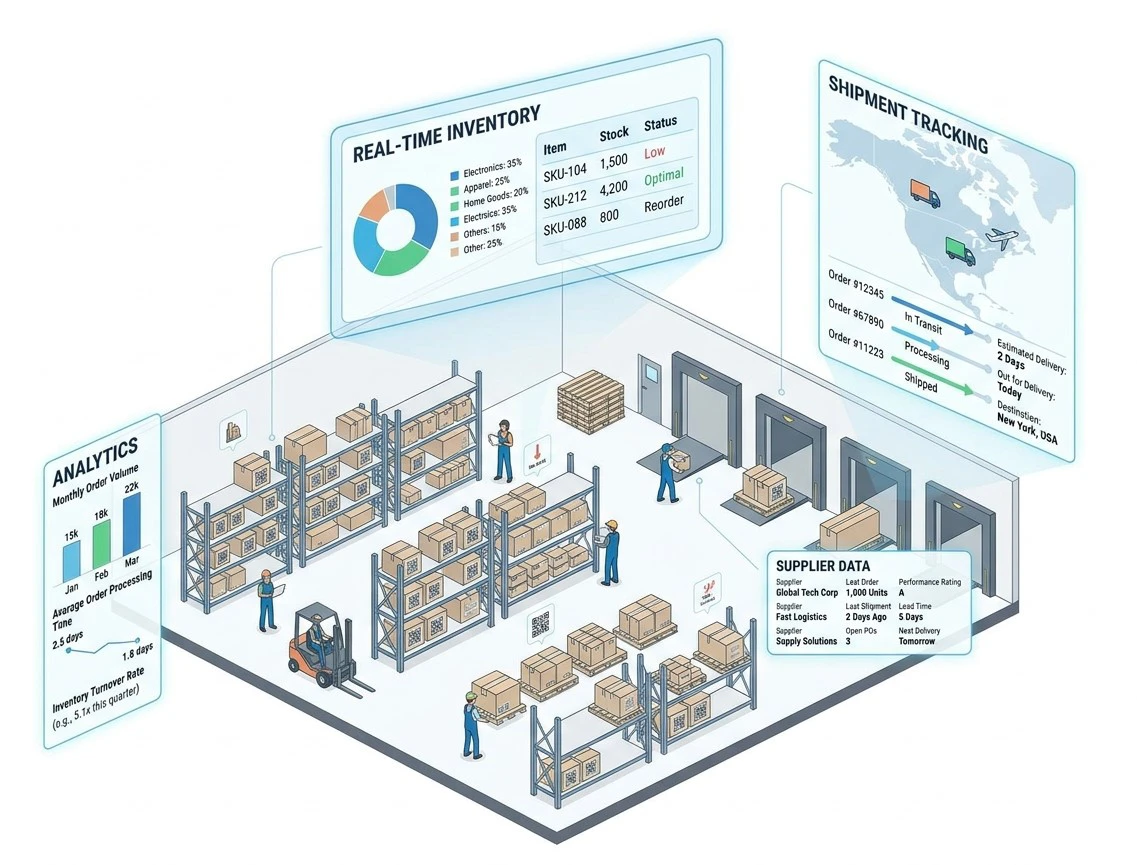
Modern logistics management software capabilities can help businesses coordinate warehouse activity, shipments, deliveries, transportation information, and order fulfilment. An ERP platform can bring logistics data together with sales, inventory, and procurement information. This gives teams greater visibility into the status of orders and helps them identify potential delays before they affect customers.
For organisations with complex distribution networks, integrating logistics management software into the ERP environment can also reduce the need to switch between disconnected applications.
Real-Time Demand Forecasting and Reporting
Demand forecasting helps businesses anticipate future requirements instead of reacting only after inventory problems occur. ERP platforms can analyse historical sales, current stock, purchasing activity, and other operational data to support planning. Dashboards and reports can then turn this information into actionable insights. Managers may monitor stock turnover, supplier performance, purchase orders, fulfilment rates, and demand trends from a central interface.
Benefits of Custom ERP Software Development Services
Businesses with specialised workflows may require more flexibility than standard platforms provide. ERP software development services allow companies to build or extend functionality around their specific operational requirements. A custom solution can connect existing applications, automate business rules, create tailored dashboards, and support workflows that do not fit neatly into a standard ERP product.
Custom ERP vs Off-the-Shelf ERP Platforms
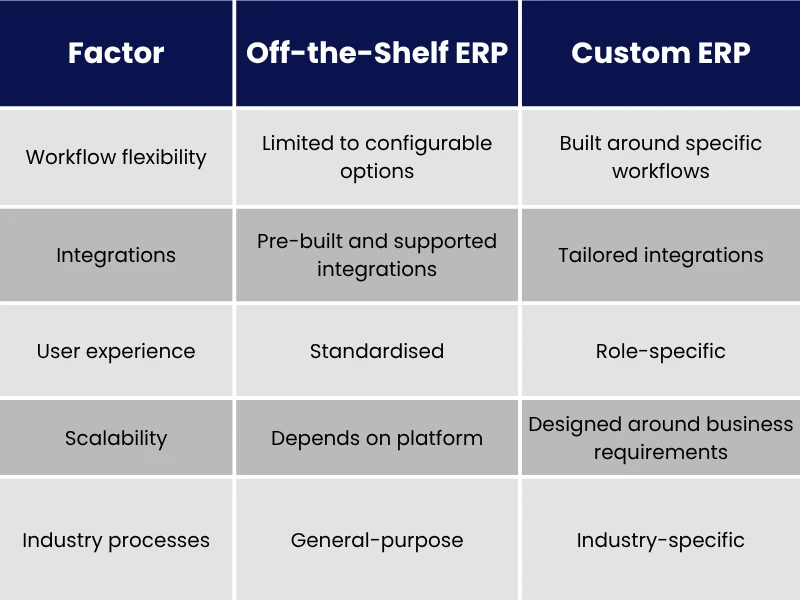
Off-the-shelf ERP systems can provide broad functionality and faster initial deployment. However, businesses may need to change established workflows to match the software. Custom ERP development takes the opposite approach: the technology is designed around the organisation's processes.
Industry-Specific Customization
Supply chains differ significantly by industry. A manufacturer may require production and raw-material tracking, while a distributor may prioritise warehouse transfers and order fulfilment. Phentech has delivered software solutions across supply-chain and warehouse-management contexts in industries such as manufacturing, distribution, retail, and wholesale, allowing ERP and SCM workflows to reflect practical operational requirements rather than generic assumptions.
This type of experience is valuable when selecting a technology partner because successful implementation depends on understanding both software architecture and the operational environment.
How to Choose the Right Supply Chain ERP Solution
Choosing ERP software for supply chain management should begin with business requirements rather than a feature checklist. Map current workflows, identify bottlenecks, document integration requirements, and determine which processes should be automated. Look for a platform that can support today's operations while remaining flexible enough for future growth.
Questions to Ask an ERP Software Development Company
Before selecting a partner, ask:
- Have you delivered ERP, SCM, or WMS solutions for similar industries?
- How will you approach custom workflows?
- What integrations can you support?
- How will data migration be handled?
- Can the platform scale across locations and users?
- How will security, testing, maintenance, and post-launch support work?
A capable ERP software development services provider should be able to explain its technical approach in business terms and demonstrate how the proposed architecture addresses specific operational requirements.
Integration With Existing Systems
ERP rarely operates alone. Businesses may already use accounting software, CRM platforms, warehouse systems, e-commerce platforms, payment services, barcode systems, or transportation applications. API-based integrations can allow these systems to exchange information while keeping the ERP platform as a central operational layer. Integration planning should cover data ownership, synchronisation frequency, authentication, error handling, and reporting requirements.
Implementation Process and Timeline
A typical ERP implementation involves discovery and requirements analysis, solution architecture, development or configuration, integrations, data migration, testing, user acceptance testing, training, deployment, and post-launch support. The timeline depends heavily on the number of modules, integrations, locations, data complexity, customisation requirements, and user groups involved. Rather than promising a universal duration, businesses should ask their implementation partner for a project-specific estimate based on the documented scope.
For complex supply-chain platforms, phased implementation can be preferable. Core inventory and procurement functions can be introduced first, followed by logistics, forecasting, advanced reporting, and additional integrations.
Building a More Connected Supply Chain
ERP software for supply chain management can turn fragmented operational data into a connected system for managing inventory, purchasing, logistics, and forecasting. The right solution does more than digitise existing processes. It creates a foundation for better visibility, automation, reporting, and scalable growth.
For businesses with complex requirements, custom development can provide the flexibility needed to connect existing systems and support industry-specific workflows. The key is choosing a technology partner that understands both the technical architecture and the realities of modern supply-chain operations.